

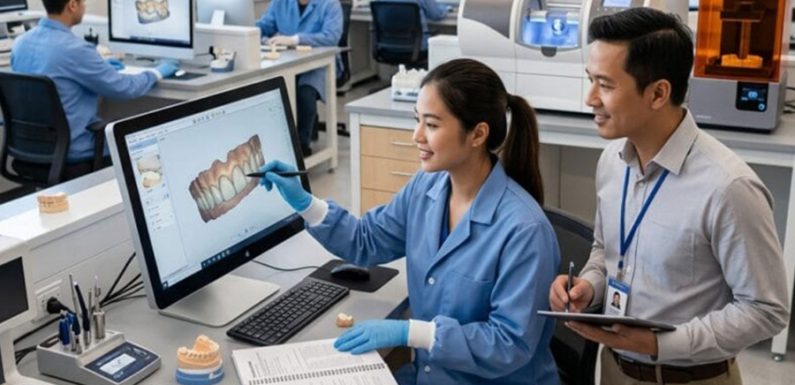
For generations, getting a dental impression meant biting into a tray of thick, chalky putty and holding still while it set, an experience that ranged from mildly unpleasant to genuinely gag-inducing, depending on how sensitive your gag reflex happened to be. That step has quietly started disappearing from more and more dental offices, replaced by a small handheld wand called an intraoral scanner.
The scanner works by capturing thousands of images per second as it’s moved around your mouth, stitching them together into a highly detailed 3D model in real time, often visible on a screen right in front of you as it builds. There’s no material to bite into, nothing to set or potentially distort, and no waiting for a tray to be removed without gagging. For many patients, especially those who’ve dreaded impressions in the past, it’s a genuinely better experience.
But the benefits go well beyond comfort. A digital scan doesn’t shrink, warp, or degrade the way impression material can during shipping or storage, which means the file that reaches a design team is a more faithful, accurate representation of your mouth than a physical impression ever was. That file can be sent electronically in seconds to a digital dental lab partner anywhere in the world, instead of needing to be physically packaged and couriered, a change that alone has cut days off typical treatment timelines.
Scans are also endlessly reusable in a way impressions never were. Need a second opinion, or a slightly different design approach? The same file can be sent out again without asking the patient to come back in for another impression.
None of this means every dental office has switched over, the scanners are a real investment, and not every practice has made the jump yet. But the direction is clear, and if your next dental visit involves a small wand instead of a tray of putty, you’re experiencing one of the more welcome technology shifts in recent dental history.
If impressions have kept you from certain treatments in the past, it may be worth asking whether your dentist has moved to digital scanning instead before ruling anything out.
